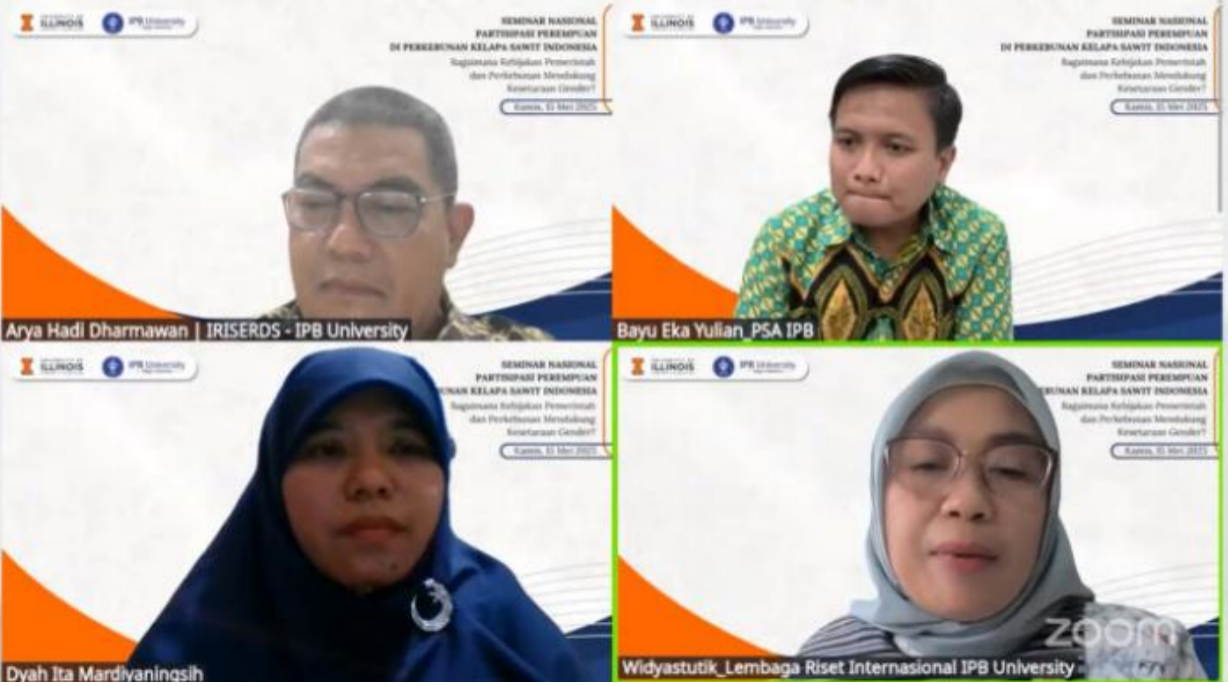
Bogor, elaeis.co – Gender equality in the palm oil plantation sector was highlighted in a national seminar entitled “Women’s Participation and Indonesian Palm Oil Plantations: How Government Plantation Policies Support Gender Equality”.
The seminar was held online by three study centers under the auspices of the International Research Institute for Social, Economic and Regional Development (LRI PSEK) IPB University. Namely the Center for Agrarian Studies, the Center for Agricultural and Rural Development Studies, and the Center for Gender and Children Studies.
This seminar presented three IPB University academics, namely Dr. Dyah Ita Mardiyaningsih, Dr. Widyastutik, and Dr. Bayu Eka Yulian. The three presented the results of collaborative research with the University of Illinois, United States, regarding the role of women in the palm oil industry and the challenges of gender equality they face.
Dyah, Secretary of the Center for Agrarian Studies, IPB University, emphasized the importance of gender-disaggregated data in formulating public policies. “Without fair data, women will continue to be marginalized from decision-making spaces,” she explained in a written statement from IPB Public Relations quoted on Friday (30/5).
She also highlighted that women palm oil workers experience a double burden and lack of recognition of their economic contribution. The research conducted in three districts (Asahan, Siak, and Kutai Kartanegara) involved 600 female respondents.
“The results show that the majority of female workers only have elementary to high school education. Therefore, affirmative policies are needed to increase women’s participation and reduce gender inequality,” she said.
Widyastutik, a lecturer in Economics from the Faculty of Economics and Management IPB, said that women are not only additional breadwinners but also the main pillar of the family economy. “They are active in household investments such as savings, livestock purchases, and property. This shows women’s financial independence amidst limitations,” she explained.
She recommended strengthening financial literacy and gender-based affirmative programs as important steps to empower women.
Meanwhile, Bayu, a lecturer at the Department of Communication Science and Community Development, IPB University, raised structural issues in the palm oil industry that are masculine and not yet friendly to women’s basic needs. He highlighted the limited facilities such as lactation rooms, proper toilets, and childcare centers.
“Wage discrimination, sexual harassment, and minimal participation in decision-making are real challenges that must be addressed immediately,” he said.
The three speakers agreed that increasing women’s participation in the palm oil industry requires a holistic approach, starting from collecting disaggregated data, financial literacy, to legal protection. The results of this study will be outlined in a policy brief for the government and companies, and published in a reputable international journal.
The main recommendations from this seminar include the preparation of affirmative policies, strengthening regulations, and providing a safe and integrated violence reporting system. It is hoped that these results can be a reference for the government and palm oil industry players to create a fairer and more inclusive work environment for women.